post

A Still Life Rooted in Green

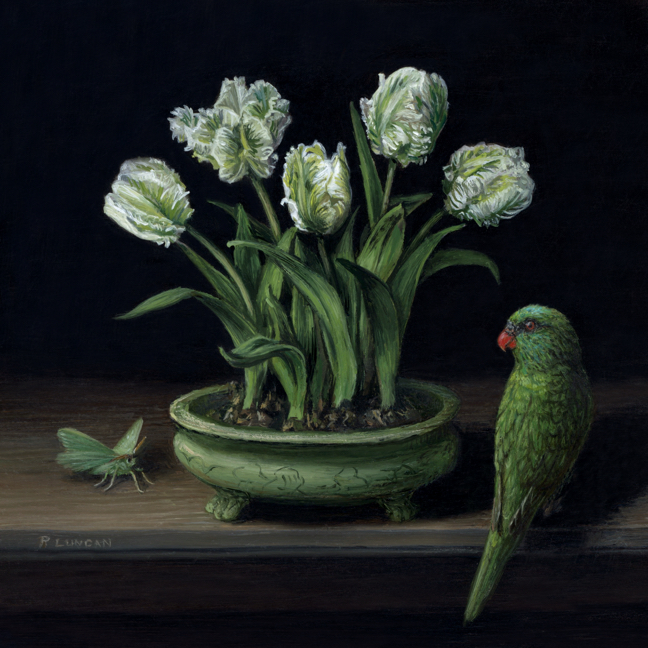
Druing the month of November, I usually find myself painting comfort foods. But this new painting in my “Chasing Color” monthly miniature  series moved in a different direction. Instead of I built a composition centered on living forms: parrot tulips with their bulbs intact, a scaly-breasted lorikeet perched at the table’s edge, and a resting emerald moth.

Green became the thread that held everything together. It moves through the painting in shifting tones, from the cool celadon of the vessel and the jade-like surface of the moth to the yellow-green veins running through the tulip petals. Even within a single flower, the color expands and contracts, never settling into one hue. The result is a still life that feels active and atmospheric at the same time, suspended between motion and stillness.

Tulips, Memory, and Celadon

The tulips form the center of the composition. I have grown many varieties in my garden, but parrot tulips remain a favorite for their movement and irregularity. Leaving the bulbs attached was important to me. It keeps them connected to their origin, suggesting growth rather than arrangement, and lends a sense of quiet persistence beneath the surface.

The vessel is inspired by a celadon tripod incense burner, a form associated with Chinese ceramics of the Ming dynasty. I was first drawn to celadon years ago while working on an installation at the Seattle Asian Art Museum. A small exhibition paired celadon vessels with intricately carved jade objects, and I remember being struck by the way the glaze seemed to hold light within it. That impression stayed with me and returned as I developed this painting.

The lorikeet carries a more personal association. Its posture and coloring recall a parrot from my childhood, a vivid presence that brought both energy and watchfulness into the home. Here, it becomes part of the quiet exchange between objects, aware and observant.
Process, Time, and Return

This painting came together gradually, shaped in intervals of concentrated work. Recent months have required a more flexible approach to studio time, working in shorter stretches and returning to the surface again and again. In some ways, that rhythm mirrors the painting itself, layered, responsive, and built through accumulation rather than a single sustained effort.

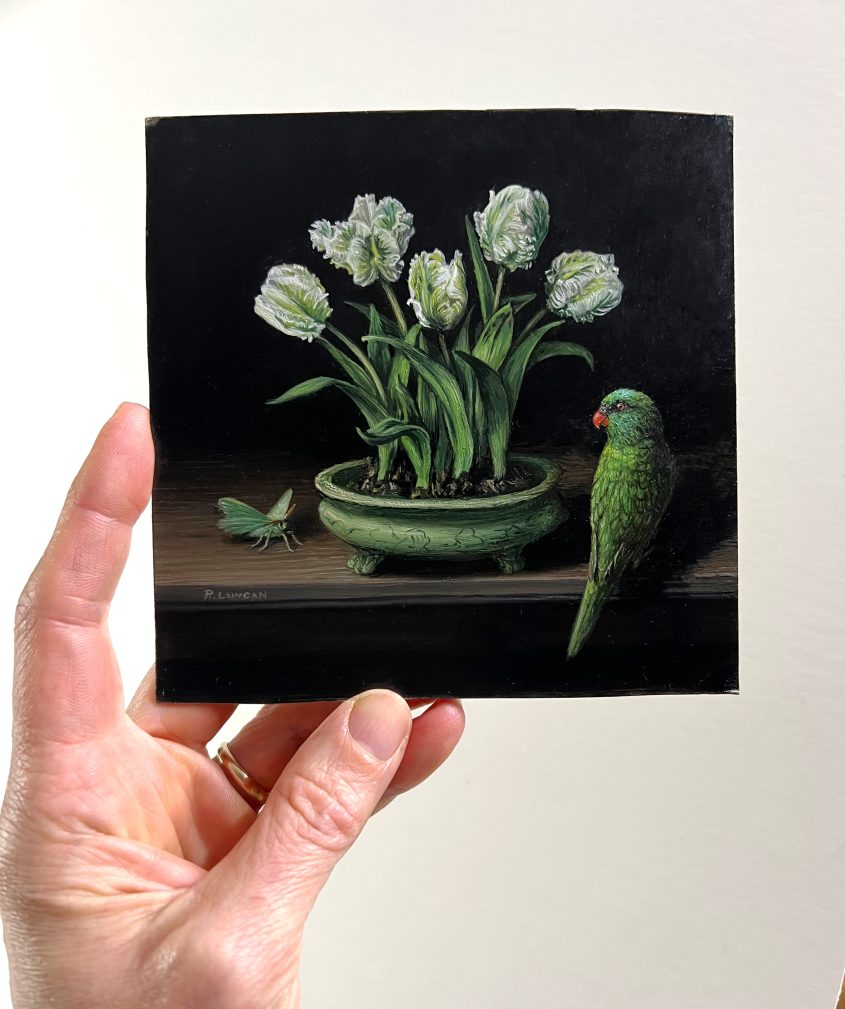
Parrot Tulips in Celadon is a 5 by 5 inch oil painting on aluminum and part of the ongoing Chasing Color series. Each piece in the series explores a single dominant hue as a way of studying mood, structure, and perception.

Green, in this case, became something more than a color. It offered a way to hold together ideas of growth, memory, and renewal, especially in a season that leans toward reflection.
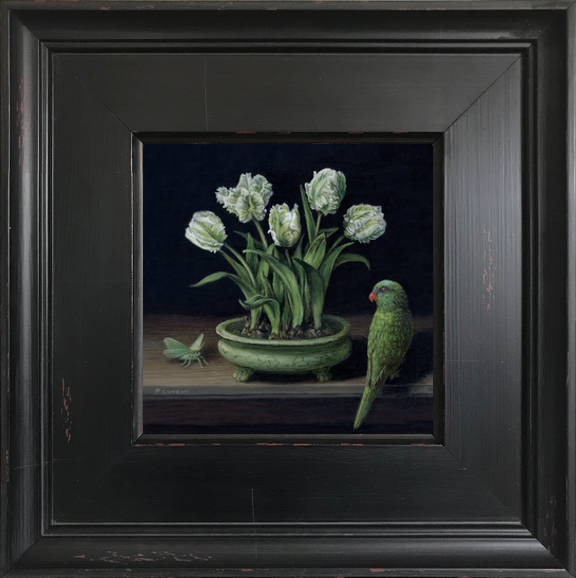
Framed miniature oil painting of parrot tulips in celadon with bird and moth, 5 x 5 inches

Receive a preview of each new Monthly Miniature in your inbox – subscribe now

post

Still life with Parrot, Oranges and a Chinese Love Story

The Western Chamber

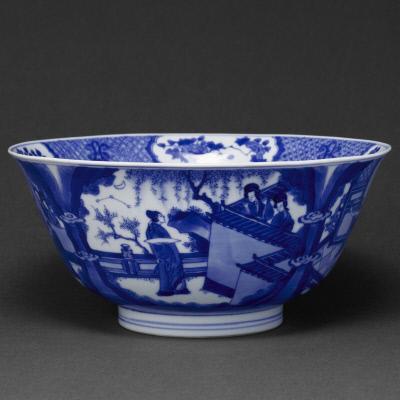
This February I wanted some romantic imagery. This 18th century bowl with its imagery of lovers in a moonlit garden was just what I was looking for. You see a poor scholar, beckoning the aristocratic beauty he has fallen in love with, who is just behind a high wall with her maid. This story, “[Romance of] The Western Chamber,” was originally written as a tragedy, but was later altered to have a happy ending. The happy version seems to dominate and there’s no hint of tragedy in the synopsis written by the Beijing Tourism Bureau. 

These little oranges are currently in season, and I loved the eye catching combination of the contrasting orange and blue. As I dreamed up this painting, I always imagined it with a parrot, never any other bird. I’ve  had a fondness for parrots ever since my dad came back from Florida with a parrot named Charlie, when I was around 8 years old. I don’t know how my mom felt about it, but that was my dad. (My sister could tell you stories about bringing a baby cow home in the back of our station wagon.) Scroll down for a picture of little Rebecca petting Charlie. 

Part of the fun of making still life paintings is to research historical symbolism and dream up my own hidden stories. Many objects have several meanings so the story can differ depending on who’s doing the dreaming. In this case, an uncaged bird symbolizes sexual freedom, and parrots specifically represent nobility, richness and self confidence. Oranges can represent abundance, longevity and beauty. 

Everything was becoming a bit too sweet and easy for the lovers, so I added a fly to bring them back down to reality. I appreciate the description by Steven Connor in his article The Painter and the Fly”, describing flies in art as the “embodiments of accident, of what just happens to happen”. And if you want to see how symbolism can be scrutinized by scholars, take a look his article which discusses the fly in art over the course of 500 years.

BOWL

Collection of the Seattle Art Museum (not currently on view)
Qing dynasty, Kangxi period (1662-1722)
Porcelain with underglaze-blue decoration, 3 3/4 in. (9.5 cm), height 8 1/4 in. (21 cm), diameter, Gift of Mrs. John C. Atwood, Jr., 70.42
Photo: Paul Macapia

“The fourteenth-century drama The West Chamber tells of a poor scholar, Zhang Sheng, seen here holding a fan, who falls passionately in love with Oriole, an aristocratic beauty. In this night scene, from behind a high wall and accompanied by her clever maid, Crimson, Oriole smiles at scholar Zhang, her hands raised in delight. Shining above them are constellations thought to determine the lovers’ fate. The scene appears to represent the two lovers by moonlight in the secrecy of the monastery garden.” Mimi Gardner Gates, “Porcelain Stories,” p. 118

The perfecting of the underglaze-blue technique made possible richer gradations of the blue color, seen particularly on wares from around the mid-seventeenth to the eighteenth century, and expanded the repertoire of design. Narrative scenes taken from lyrics, plays, and popular novels (like The West Chamber depicted on the bowl) became fashionable around this time, catering to the interests of the rising merchant class and the scholar gentry alike. These interpretive blue paintings told intimate stories to the viewer, and enriched the surface of the blue-and-white porcelain. 

How to Purchase

Subscribe to my newsletter to get an email when each Monthly Miniature is finished and the chance to purchase the latest painting. I usually announce when the newest painting will be released for sale on Instagram and Facebook within 24 hours before sending the newsletter.